Arduino Stepper Motor Serial Control
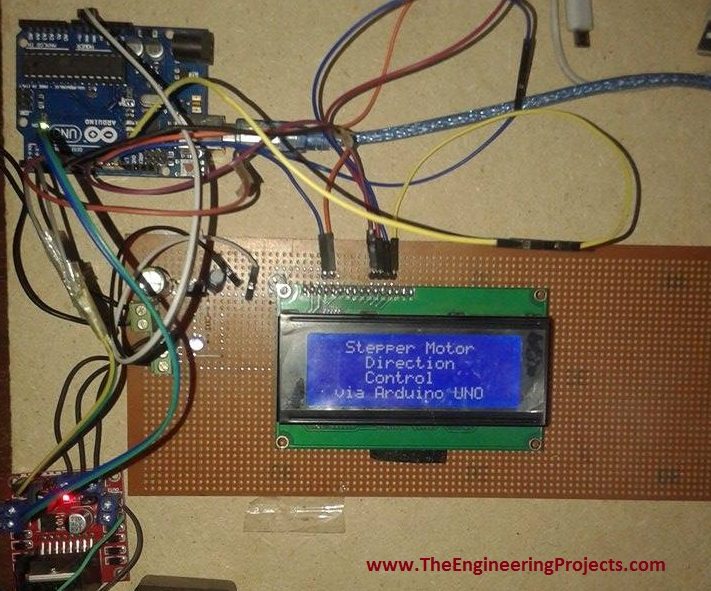
How to make a perfect stepper motor control using Arduino - circuit diagram with working process and list of components with code, output video. In this tutorial we will learn basics and working of stepper motors and then will interface stepper motor with arduino uno and write the arduino stepper motor control. Today, I am going to tell you that how to make a simple algorithm for Stepper Motor Speed Control using Arduino. I have already. Doing the number of stepper motor using the Arduino Stepper Library. Stepper Motor Control. // initialize the serial port.
Stepper motors are increasingly taking its position in the world of the electronics. Starting from a normal Surveillance camera to a complicated CNC machines/Robot these Stepper Motors are used everywhere as actuators since they provide accurate controlling. In this tutorial we will learn about the most commonly/cheaply available stepper motor 28-BYJ48 and how to interface it with Arduino using ULN2003 stepper module. Stepper Motors: Let us take a look at this 28-BYJ48 Stepper motor. Okay, so unlike a normal DC motor this one has five wires of all fancy colors coming out of it and why is it so?
To understand this we should first know how a stepper works and what its specialty is. First of all steppers motors do not rotate, they step and so they also known as step motors.
Meaning, they will move only one step at a time. These motors have a sequence of coils present in them and these coils have to be energized in a particular fashion to make the motor rotate. When each coil is being energized the motor takes a step and a sequence of energization will make the motor take continuous steps, thus making it to rotate.
Let us take a look at the coils present inside the motor to know exactly know from where these wires come from. As you can see the motor has Unipolar 5-lead coil arrangement. There are four coils which have to be energized in a particular sequence. The Red wires will be supplied with +5V and the remaining four wires will be pulled to ground for triggering the respective coil.
We use a microcontroller like Arduino energize these coils in a particular sequence and make the motor perform the required number of steps. So now, why is this motor called the 28-BYJ48? I don’t know. There is no technical reason for this motor for being named so; maybe we should dive much deeper into it. Let us look at some of the important technical data obtained from the datasheet of this motor in the picture below. That is a head full of information, but we need to look at few important ones to know what type of stepper we are using so that we can program it efficiently. Download Lagu The Overtune Sayap Pelindungmu on this page. First we know that it is a 5V Stepper motor since we energize the Red wire with 5V.
Then, we also know that it is a four phase stepper motor since it had four coils in it. Now, the gear ratio is given to be 1:64. This means the shaft that you see outside will make one complete rotation only if the motor inside rotates for 64 times. This is because of the gears that are connected between the motor and output shaft, these gears help in increasing the torque. Another important data to notice is the Stride Angle: 5.625°/64.
This means that the motor when operates in 8-step sequence will move 5.625 degree for each step and it will take 64 steps (5.625*64=360) to complete one full rotation. Calculating the Steps per Revolution for Stepper Motor: It is important to know how to calculate the steps per Revolution for your stepper motor because only then you can program it effectively.
In Arduino we will be operating the motor in 4-step sequence so the stride angle will be 11.25° since it is 5.625°(given in datasheet) for 8 step sequence it will be 11.25° (5.625*2=11.25). Steps per revolution = 360/step angle Here, 360/11. Cakewalk Home Studio 9 Crack. 25 = 32 steps per revolution. Why so we need Driver modules for Stepper motors? Most stepper motors will operate only with the help of a driver module. This is because the controller module (In our case Arduino) will not be able to provide enough current from its I/O pins for the motor to operate.